
The Employee Assistance Program (EAP) helps you privately solve problems that may interfere with your work, family, and life in general. EAP services are FREE to you, your dependents, and all household members. EAP services are confidential and provided by experts.
GuidanceResources provides EAP services 24/7 to all employees, State Plan members, their dependents and household members.
 |
|
|
Note: You must contact GuidanceResources for approval before scheduling an appointment with a counselor to ensure your first six visits are covered under the EAP benefit. Dependent or household member will need to provide the first and last name of the employee/State Plan member who provided you with the GuidanceResources contact information. The online chat function is available Monday- Friday 7:00am – 5:00pm MST. |
|






Employee Assistance Program Services
Sometimes life can feel overwhelming. It doesn’t have to. GuidanceResources provides confidential counseling, expert guidance and valuable resources to help you handle any of life’s challenges, big or small. Learn how the Employee Assistance Program can support you and your household by reviewing this informative flyer.
-
Anxiety, depression, stress
-
Grief, loss and life adjustments
-
Relationship/marital conflicts
-
Finding child and elder care
-
Hiring movers or home repair contractors
-
Planning events, locating pet care
-
Retirement planning, taxes
-
Relocation, mortgages, insurance
-
Identity theft support
-
Budgeting, debt, bankruptcy and more
-
Divorce, adoption and family law
-
Real estate, foreclosure, landlord/tenant issues
-
Free consultation and discounted local representation
-
Quickly and easily complete a will on your computer with EstateGuidance
-
Specify guardians, trustees and property division
-
Provide funeral and burial instructions
-
Self-care platform offers guided health programs
-
Tackle anxiety, depression, stress
-
Improve mindfulness, sleep, and more
-
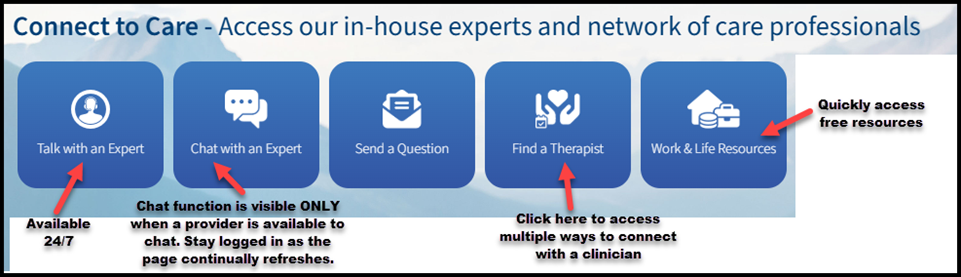
Online Tips and Tricks: Once you are have registered and signed into your account, there are several ways to get connected with services. The chat function is available Monday- Friday 7:00 – 5:00 MST and is a great way to request an answer.
Free Webinars and Training
Watch this GuidanceResouces Orientation on-demand presentation about EAP services.
Scheduled Trainings - All Session Times are 12:00-1:00 p.m. MST
- April 7: How to Deal With a Difficult Person (Details)
- April 8: Initiating Difficult Conversations (Details)
- April 15: Managing Anger at Home and at Work (Details)
- April 22: How to Receive Criticism and Make it Work for You (Details)
- April 23: Building Respectful Relationships (Details)
- April 28: Using Reason to Resolve Conflict (Details)
- April 29: Civility in the Workplace (Details)
Huddles
On Demand Training Opportunities
Training sessions are available on-demand, simply click the link below to start learning.
-
Mental Health Safety Plan: Safety Plan & Instructions
-
Suicide Awareness Presentation (contact eap@mt.gov for closed captioning or alternate formats)
Managers' Corner
The EAP provides no-cost specialized resources and trainings to help supervisors support their employees.
Management-Focused Training Courses - All Session Times are 12:00-1:00 p.m. MST
- LinkedIn Training: Talking About Mental Health as a Leader (on-demand)
- April 14: Addressing Employee Performance Issues in a Supportive Way (Details)
- April 21: High-Impact Feedback: On the Spot, On the Floor (Details)
On-Demand Trainings
-
Brining Out the Best in Others - on-demand presentation
-
For Managers: Your Employee Assistance Program - services overview flyer
-
Critical Incident Support – request for an on-site counselor for your team
-
Leading with Authenticity - on-demand presentation
-
Manager Orientation - on-demand presentation
-
Managing Remote (or hybrid) Employees - on-demand presentation
-
Managing Staff Through Stressful Situations - on-demand presentation
- Psychological Safety in the Workplace - on-demand presentation
-
GuidanceResouces Training Catalog - Choose from a list of workshops to provide behavioral health or professional training to your group. All trainings must be coordinated through the EAP Program Manager, Ann Brewer, at eap@mt.gov.
Manager Support
The Cost of Conflict and How to Bounce Back
Conflict is an inevitable part of life and relationships. When we think about conflict, the way we respond sometimes models the way we were taught to respond as children. We may have been taught that success was measured by right or wrong, winning or losing, good or bad, instead of finding the best answer through collaboration and understanding. Does conflict require an “all or nothing” outcome, and if not, how do we move past the cause of the conflict?
When relationships fracture, even temporarily, they become major sources of frustration. Destructive conflicts in the workplace can lead to absenteeism, productivity loss, mental health issues, grievances, and turnover. Relationships in the workplace aren’t that different from relationships outside the workplace, and the losses from these conflicts can carry over for a lengthy period if left unchecked. It is important that managers and employees know how to manage and rebound from conflict. (Cheng, Jocelyn. October 22, 2018)
Common causes might include expectations, values, needs, or goals that don’t match up; differences in perceptions (motives, words, actions, or situations) or an unwillingness to cooperate or compromise to achieve a resolution. Albert Einstein said this best, “We cannot solve our problems with the same level of thinking that created them.”
The conflict happened. Where do we go from here? Consider the following ideas to start the conversation.
- Plan for the conversation. How would you have handled things differently? Where did things go wrong? How could you have made a different outcome?
- Ask for permission to revisit the incident. Is the other person open to reflect on the situation?
- Offer an apology. An apology is the most-essential olive branch to make peace with conflict. Healing starts with admitting that you could have done things differently.
- Identify using effective phrases, such as “I’m learning to be better . . .” and “I’d like to work on being . . .”
- Ask for feedback. Learn from others’ perspective by asking how they think you could have done things differently.
Conflict resolution involves taking time to understand all sides. Use active listening, and follow up with calm communication using compromise and a commitment to finding mutually agreeable outcomes. (4 Creative Ways to Resolve Conflict. September 17, 2019)
Bonus - free resources for extra support and connection: